How to Play Backgammon (Tavla)
Backgammon, called tavla in Turkey, is a strategy game for two players with 15 checkers each and two dice on a board of 24 points. You move checkers by the numbers rolled, hit single opposing checkers and bring everything home to bear off first. In Turkish rules a shutout win is a gammon.
The aim of the game
The aim is to move all 15 checkers around the board into your home board and bear them off before your opponent. The first to bear off every checker wins the game. If your opponent has not borne off a single checker by then, the win counts double: a gammon.
Luck with the dice matters, but decisions win games: which checker to move, whether to leave a blot, when to make a point and block your opponent. A good player weighs several options on every roll and picks the one with the smaller risk.
Backgammon is the classic game of Turkish coffeehouses and homes, where it is known as tavla. On miniOkey we play Turkish-style: no doubling cube, a gammon scores 2, and matches go to 3, 5 or 7 points.
Board, checkers and setup
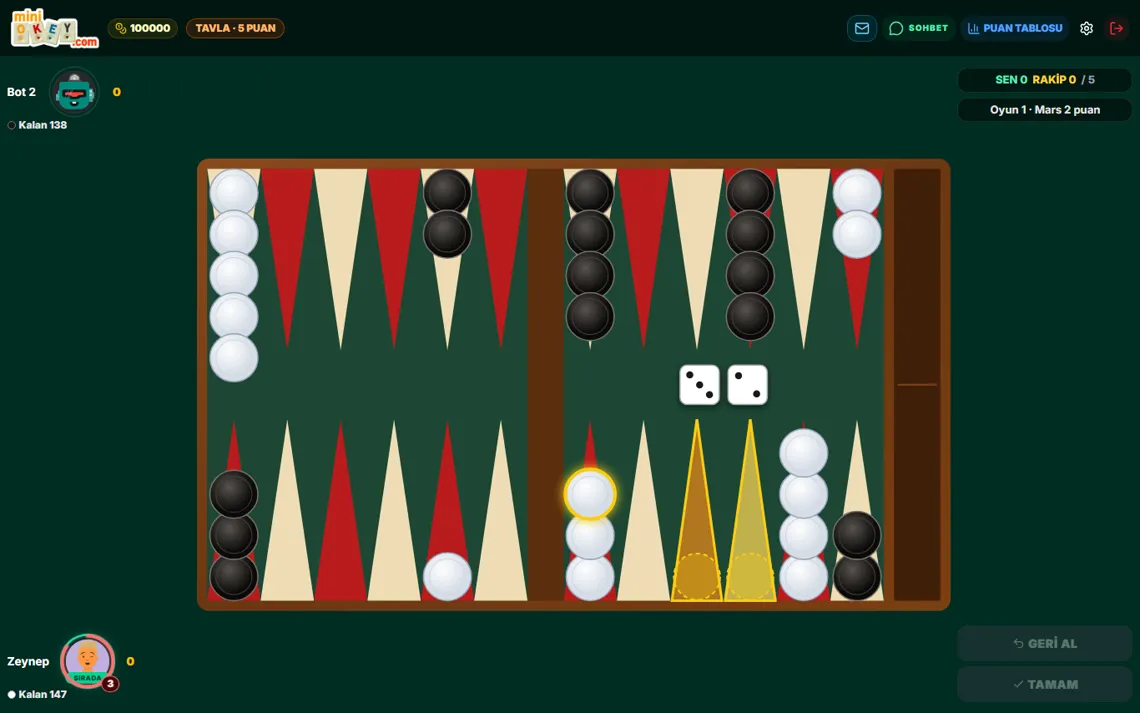
The board is split in two by the bar in the middle and has 24 points. Each player has 15 checkers: on miniOkey you always play white at the bottom, moving from point 24 down to 1. Your home board is points 1–6 at the bottom right; your opponent's home is at the top right. Borne-off checkers go to the tray on the right.
At the start everyone sets up the same way: 2 checkers on point 24, 5 on 13, 3 on 8 and 5 on 6. Your opponent mirrors this on the other half. Each player card shows the pip count — the total distance of your checkers from home — so you can follow the race.
Each number rolled is a separate move: roll 5-3 and you move one checker 5 and one checker 3 (or the same checker 8). Doubles such as 4-4 give you four moves.
Step by step
- 1
Opening roll
Each player rolls one die; the higher roll starts and rolls both dice again. A tie is rerolled.
- 2
Roll the dice
On your turn press ROLL to throw both dice. Dice are rolled on the server and shown on the board.
- 3
Pick a checker
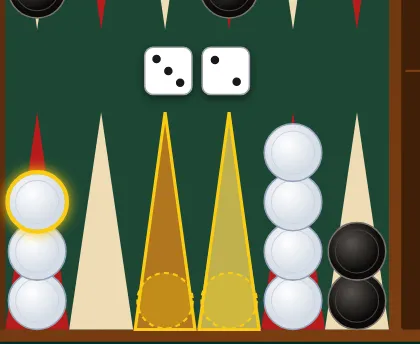
Tap the checker you want to move; the points it can reach turn yellow. A point reached with both dice shows "5+3".
- 4
Make the move
Tap a yellow point or drag the checker there. One move per die; doubles give four moves.
- 5
Send your turn
When all dice are played, press DONE to send the turn; until then you can UNDO any move.
- 6
Bear off
When all your checkers are home, move them to the tray. Double-clicking a checker bears it off directly.
- 7
Game and match end
The first to bear off all checkers wins: 1 point, or 2 for a gammon. The first to reach the match score (3, 5 or 7) wins.
Key rules and terms
Moving and forced moves
A checker moves as many points as the die shows and may land on an empty point, a point with your own checkers, or a point with a single opposing checker. If both dice can be played you must play both; if only one can, you must play the larger.
If no move is possible, the turn passes and the screen says "no moves". miniOkey applies all of this for you: only legal points light up and an incomplete or illegal turn cannot be sent.
Points (blocking)
If you have two or more checkers on a point, you own that point: your opponent cannot land there. Points protect your checkers and block your opponent's path.
Points in your home board (1–6) and just in front of it are especially valuable. If your opponent has a checker on the bar, every point you own at home makes entering harder.
Hitting and blots
A single checker on a point is a blot. If your opponent lands on it, it is hit and goes to the bar in the middle. A hit checker has to travel the whole way home again.
Hitting sends your opponent back and gains you time. Leaving a blot is sometimes unavoidable; then try to leave it where your opponent is unlikely to hit it.
Entering from the bar
With a checker on the bar you must enter it first; nothing else may move until it does. It enters your opponent's home board: a 2 enters on point 23, a 6 on point 19.
If the point is closed you cannot enter with that die; if both dice point to closed points the turn passes. On miniOkey the hit checker is selected automatically and its entry point lights up.
Bearing off
When all your checkers are in your home board (1–6) you start bearing off: the checker on the point matching the die goes to the tray. If the die is larger than your farthest checker, you bear off the farthest one.
With a die that has no exact match while you still have checkers farther back, you must move inside instead. If one of your checkers is hit while bearing off, you stop until it comes home. Double-clicking a checker bears it off.
Gammon
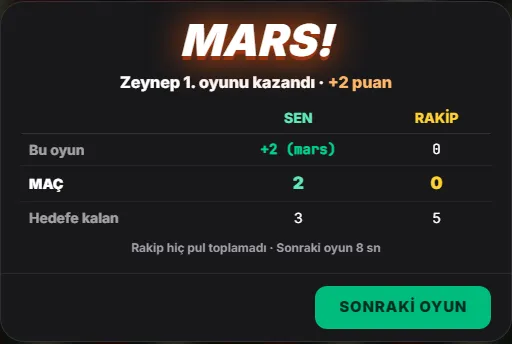
If you bear off all your checkers before your opponent has borne off any, you win a gammon worth 2 points. If they bore off at least one, the win is worth 1.
Turkish rules have no doubling cube and no triple backgammon score. When you win a gammon a big "GAMMON!" appears and the points go to the match score.
Opening and later games
In the first game of a match each player rolls one die; the higher roll starts and rolls both dice again (the common Turkish rule). A match is made of several games.
Later games are started by the winner of the previous game. At the start of each game the checkers are set up again and the screen shows who starts.
Scoring: game, gammon and match
Each game of backgammon is worth one or two points, and points add up over the match. On miniOkey the scoring is automatic: the end-of-game window shows the points of this game, the match score and the points still needed.
Game points
| Normal win (opponent bore off at least 1) | +1 |
| Gammon (opponent bore off none) | +2 |
Not used in Turkish rules
| Doubling cube | none |
| Backgammon (triple) | none |
Example match (5 points)
| You — 1 + 1 + gammon 2 | 4 |
| Opponent — 1 | 1 |
| Win the fifth game and the match is yours | 5 |
End of match and gold
The table creator picks the match length: 3, 5 or 7 points. The first to reach it wins. The winner gets their own stake back plus the opponent's stake (minus a 5% site fee); the loser loses the stake. To avoid endless matches at most 25 games are played; then the higher score wins.
Strategy Tips
- Avoid leaving blots your opponent can hit; if you must, leave them far from your opponent's checkers.
- Make points in and in front of your home board: a hit opponent will struggle to enter.
- Several points in a row (a prime) trap your opponent's back checkers.
- When you are ahead in the race (lower pip count), bring your checkers home safely.
- When you are behind, holding a point in your opponent's home board gives you chances to hit.
Frequently Asked Questions
How many players does backgammon need?
Backgammon is a game for two players; each has 15 checkers and rolls two dice on their turn. On miniOkey a real player can join your table, or if you would rather not wait, add a bot to the empty seat and start right away. Backgammon tables have their own lobby filter.
What is a gammon and how much is it worth?
If you bear off all your checkers while your opponent has not borne off a single one, you win a gammon and score 2 points. If they bore off at least one, the win is worth 1. Turkish rules have no triple backgammon and no doubling cube, so a game scores at most 2.
What happens when I roll doubles?
With doubles, for example 4-4, you make four moves of that number: the same checker four times or different checkers four times in total. On miniOkey four dice appear when you roll doubles, played dice fade out and the screen tells you how many moves are left.
How does a hit checker re-enter?
A hit checker goes to the bar, and you must enter it into your opponent's home board before moving anything else. A 1 enters on point 24, a 6 on point 19. If the point is closed you cannot enter with that die; if both dice point to closed points, the turn passes.
Which die do I play if only one can be used?
The rule is: if both dice can be played you must play both. If only one can be played, you must play the larger one. miniOkey applies this rule for you; impossible moves do not light up and the DONE button stays disabled until the dice are used, so an illegal turn cannot be sent.
Are the dice really random?
Yes. Dice are rolled with a secure random source on the game server, not on your device or your opponent's. Every roll is written to the match log and can be checked when needed. The bot plays with the same dice; nobody gets an advantage and everyone follows the same rules.
What happens if my time runs out?
Since a turn means rolling and making several moves, each turn has 45 seconds, with a one-time 45-second extension per game if needed. If that also runs out, the game rolls for you and plays the best move. In settings you can turn on automatic dice rolling and keep your time for the move.
How long is a match and who starts?
The table creator picks a match of 3, 5 or 7 points; the default is 5. In the first game each player rolls one die, the higher roll starts and rolls both dice again. Later games are started by the winner of the previous game. The first to reach the match score wins.
Now that you know the rules, play backgammon for free. Other guides are waiting too: How to Play Pisti and How to Play Okey.
Ready? Take a seat
You know the rules — now try them against real players on miniOkey Web, no installation needed.
Play Backgammon Now