How to Play 101 Okey
101 Okey is an okey variant played by four players with 106 tiles. The goal is to open your hand with sets worth at least 101 points, shed your tiles onto the table to be the first to finish, and end the match with the lowest penalty score.
The goal of the game
Every hand of 101 Okey is a race between two goals: opening your hand by passing the 101-point threshold and getting rid of your tiles before everyone else. When a hand ends, players who could not open or still hold tiles receive penalty points; the results are written to the score sheet after every hand. When the chosen number of hands is complete, the player with the fewest penalty points wins. So 101 is a strategy game played over a series, not a single hand; even after a bad hand, careful play can turn the series around.
Tiles and dealing
Tiles come in 4 colours: red · black · blue · yellow. There are two tiles of every number in every colour.
The game uses 106 tiles: two sets of the numbers 1 to 13 in 4 colours (104 tiles) plus 2 false okeys. Each player is dealt 21 tiles; the first player starts with 22 and discards on their first move without drawing. A false okey is not a joker: for that hand it stands in for the real okey tile, with its number and colour. The joker role belongs to the real okey, which is determined by the indicator.
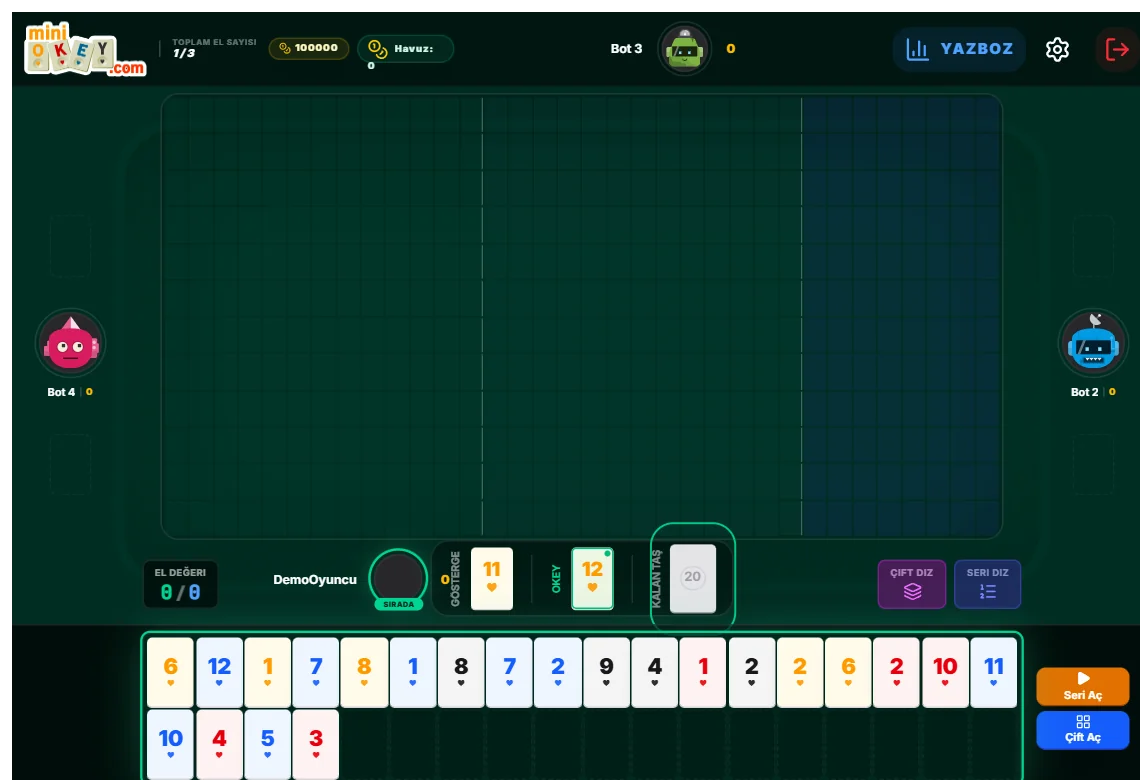
How to play 101 Okey, step by step
- 1
Take a seat and get your tiles
At a four-player table each player is dealt 21 tiles; the first player gets 22. Your tiles are arranged on your rack.
- 2
Check the indicator to find the okey
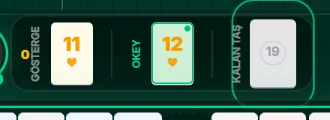
The tile one higher than the face-up indicator tile, in the same colour, is the okey of that hand. The okey is the joker that can replace any tile.
- 3
Draw a tile on your turn
When it is your turn, draw one tile either from the face-down pile or from the tiles discarded by the player on your left. You always hold one extra tile.
- 4
Build your sets and open with 101
Build runs (same colour, consecutive) or groups (same number, different colours). Once your sets are worth at least 101 you can open your hand on the table. Alternatively you can open with at least 5 pairs.
- 5
Add tiles after opening
Once you have opened, shed your hand by adding suitable tiles to the sets on the table. You discard one tile at the end of every turn.
- 6
Finish your hand
Lay down or add all your tiles and discard your last one to finish the hand. When a hand ends, the tiles left in your opponents’ hands are scored as penalty points; after all hands, the player with the fewest penalties wins.
Key concepts
What is a set?
A set (per) is a valid arrangement of at least 3 tiles. There are two kinds:
The indicator and the okey
At the start of each hand an indicator tile is turned up in the middle; the tile one higher in the same colour is the okey of that hand. The okey replaces any tile and is counted at the value of the tile it replaces.
Opening your hand (the 101 threshold)
Laying sets on the table for the first time is called opening. The sets you open with must total at least 101 — that is where the game gets its name. In doubling mode, if someone opened before you, you have to beat their score.
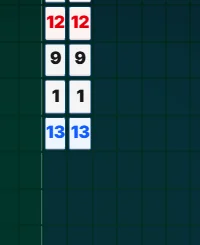
Total 105 ≥ 101 → this hand can be opened.
On miniOkey Web, once your hand is ready just press Open Series or Open Pairs — the game adds up your sets for you and lays your tiles on the table if you pass 101.
What do opened sets look like on the table?
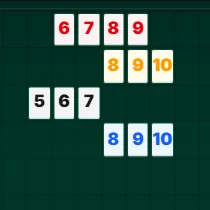
Opened sets are laid out on the table each in its own row, one under the other. That way everyone can see who opened what and which sets can take more tiles.
Going for pairs
Instead of sets you can also open your hand with pairs: two identical tiles make a pair, and you need at least 5 pairs to open. Pairs are also laid out one per row. If you finish the hand by pairing up your remaining tiles too, you earn a big reward.
Bot players — start without waiting
One of miniOkey Web's best-loved features: when you set up your own table you can fill the empty seats with bots (computer players). You never wait for the table to fill — even if you are the only real player, you start playing against three bots instantly. Playing against bots is the best way to try out the finer points of opening and adding tiles in 101 without risk; once you feel confident, move on to tables with real players.
Adding tiles
After opening you can add suitable tiles from your rack to the sets on the table — both your own and your opponents'. For example, if there is a 5-6-7 run on the table you can add your 8 to its end. Adding tiles is the fastest way to shed your hand. On miniOkey Web you can take back the tiles you laid down during the same turn with Undo Collect; but if you try to open and take your tiles back, you get 101 penalty points — so do your sums before you open.
Scoring and penalties
In 101 the score is a penalty count: at the end of every hand points are written down for everyone, and when the chosen hands are over the player with the lowest total wins the match. The player who finishes gets minus points (a reward); everyone else is penalised for the tiles left in their hand. On miniOkey Web the game does all the arithmetic automatically; you can follow the hand-by-hand breakdown on the Scoreboard in the top menu.
The player who finishes
| Opening with sets (runs / groups) and finishing | −101 |
| Opening with pairs and finishing | −202 |
| Finishing by discarding the okey as the last tile | twice the above (−202 / −404) |
Penalties for the other players
| Never opened their hand | 202 |
| Opened: each normal tile left in hand | its face value |
| Okey tile left in hand | 101 |
| False okey left in hand | face value of the okey |
| Opened with pairs | penalty in hand doubled |
What doubles the penalty
Each of the following doubles the penalty of the players who did not finish; if more than one happens in the same hand the multipliers stack (2 cases = 4 times, 3 cases = 8 times). The 202 of a player who never opened is doubled too.
- Finishing in one go: the winner finished in the same turn they opened.
- Going for pairs: the winner opened with pairs.
- Finishing with the okey: the winner discarded the okey as their last tile.
Penalties during the game
| Discarding a tile that could be added to a set on the table (a playable tile) | +101 |
| Discarding the okey tile | +101 |
| Trying to open, falling short of 101 and taking the tiles back | +101 |
No playable-tile or okey penalty applies to the final discard that finishes the hand. After you have opened, you can take back the moves of that same turn without penalty.
If the pile runs out
If the pile runs out before anyone finishes, the hand has no winner: a player who never opened gets 202, a player who opened is penalised for the tiles left in hand (doubled if they opened with pairs). The doubling cases do not apply here.
Example hand
| Ayşe — finished, with the okey | −202 |
| Mehmet — opened; 3, 7 and the okey left (3 + 7 + 101 = 111) × 2 | 222 |
| Can — opened; a single 5 left (5) × 2 | 10 |
| Zeynep — never opened (202) × 2 | 404 |
End of the match and gold
When the number of hands chosen by the table host (1, 3, 5, 7 or 11) is over, the totals are ranked. Every member at the table puts gold worth the table value into the pot. First place takes the pot (three times the table value minus a 5% site fee as net winnings; e.g. 712 gold at a 250 table), second place gets their entry gold back, third and fourth get nothing. First place also earns 200 XP, the others 50 XP. Guest players do not receive gold or XP.
Strategy Tips
- Opening early is not always profitable: once you open, your opponents can add tiles to your sets too. If your hand is coming together, waiting a turn or two to open high pays off in doubling mode.
- Think twice before spending the okey on a set — but do not sit on it either: an okey left in hand when the hand ends costs 101 penalty points on its own.
- Watch the tiles your opponents discard. If the consecutive tiles of a colour never get thrown, someone is collecting that run.
- Decide early whether to go for pairs: if your hand is heavy on pairs, focus on completing 5 pairs instead of chasing sets.
- As the hand nears its end, get rid of high-numbered tiles early; if the hand finishes, your penalty will be smaller.
- Check the score sheet after every hand: if you are ahead avoid risky openings; if you are behind, try to close the gap with pairs or a high opening.
Frequently Asked Questions
How many points do you need to open in 101 okey?
Your sets must be worth at least 101 points. The face values of the tiles in your sets are added up; if the total is 101 or more you can open your hand. You cannot put tiles on the table before reaching this threshold.
How many tiles does a set need?
Every set has at least 3 tiles. There are two kinds: a run of consecutive numbers in the same colour, or a group of the same number in different colours.
What is going for pairs, and how many pairs do you need?
It means opening your hand with pairs instead of sets. Two identical tiles make a pair, and you need at least 5 pairs to open. Each pair is laid out in its own row on the table.
What penalty does a player who never opened get?
A player who has not opened their hand by the end of the hand gets 202 penalty points. If the winner finished in the same turn they opened, went for pairs or finished by discarding the okey, this penalty is doubled for each of those.
Can the okey tile be used in a set?
Yes. The okey replaces any tile you want (it is the joker) and completes unfinished sets. It is also counted at the value of the tile it replaces, which makes opening easier.
What is the penalty for an okey left in hand?
If you still hold the okey when the hand ends, it alone costs you 101 penalty points. A false okey is penalised at the face value of the okey tile. Holding on to the okey to drag out the hand is therefore risky.
What can I do after opening?
After opening you can add suitable tiles from your rack to the sets on the table — both your own and your opponents’. This lets you shed your tiles quickly and get closer to finishing the hand.
How many players and tiles are used in 101 okey?
Standard 101 okey is played by 4 players with 106 tiles: two sets of the numbers 1–13 in 4 colours, plus 2 false okeys. Each player gets 21 tiles; the first player starts with 22.
What is doubling (katlamalı) 101?
In doubling mode, everyone who opens after the first player must open with a higher total than the last opening. This makes the game more strategic and competitive.
Can I add bots to my table?
Yes. When you set up your own table you can fill the empty seats with as many bots (computer players) as you like. You start right away without waiting for players; playing against bots is also ideal for learning the 101 rules and practising.
Can I start a new match at the same table when one ends?
Yes. When the match ends, the "New Game" button starts a new match at the same table with the same settings in one click — no trip back to the lobby. Drawing and discarding happen instantly, so play stays fast and uninterrupted.
Want to learn the rules of classic okey too? Read How to Play Okey; if you feel ready, play 101 for free.
Ready? Take a seat
You know the rules — now try them against real players on miniOkey Web, no installation needed.
Play 101 Now