How to Play Okey
Okey is a classic table game for four players using 106 tiles. Each player tries to arrange their 14 tiles into runs and groups; the first to complete their hand and discard their last tile wins the hand. The okey tile, determined by the indicator, is a joker that can replace any tile.
The goal of the game
The goal is to be the first player to arrange all 14 of your tiles into valid sets — runs and groups. Once your hand is complete you discard your remaining tile and the hand ends. Finishing with 7 pairs or by discarding the okey as your last tile is worth more than a normal finish. Okey is a game of speed and attention: while building your own hand you also watch the tiles your opponents draw and discard; sensing who is collecting which run tells you which tiles are safe to throw.
Tiles and dealing
Tiles come in 4 colours: red · black · blue · yellow. There are two tiles of every number in every colour.
There are 106 tiles: two sets of the numbers 1–13 in 4 colours plus 2 false okeys. Each player is dealt 14 tiles; the starting player gets 15 and discards on their first move without drawing. The remaining tiles stay in the middle as a face-down pile; each player's discards pile up in their own corner of the table, so you can see who threw what throughout the hand.
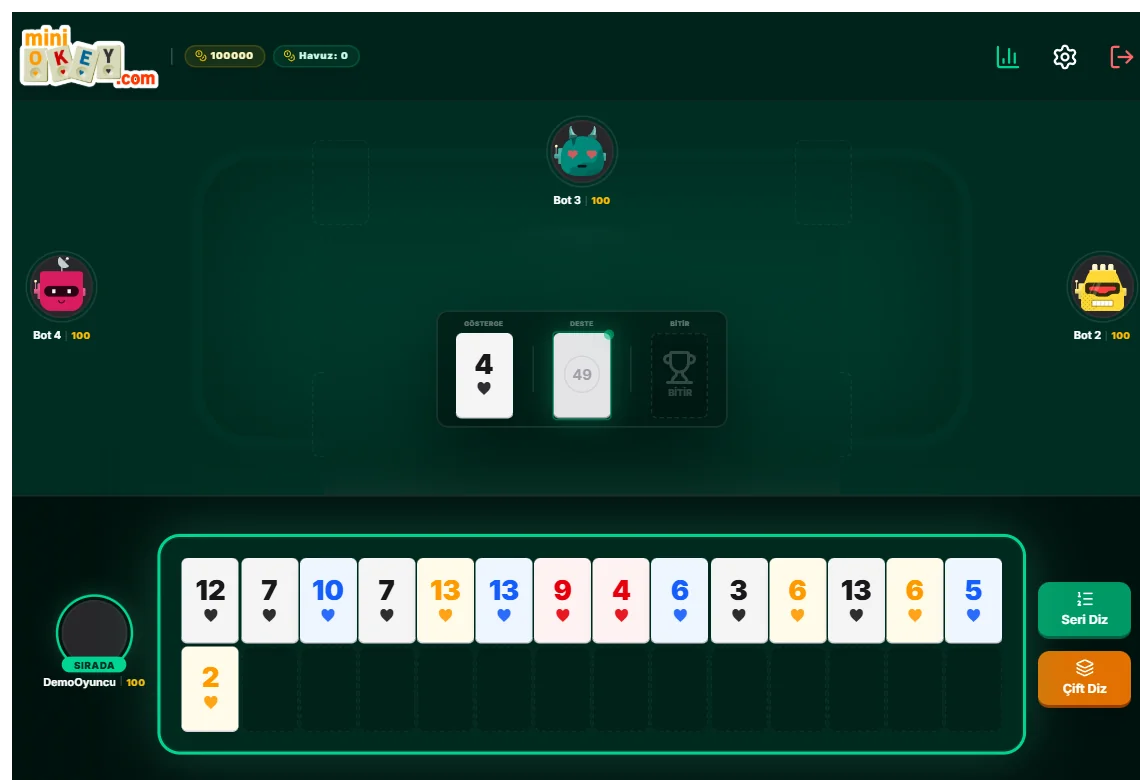
How to play okey, step by step
- 1
Take a seat and get your tiles
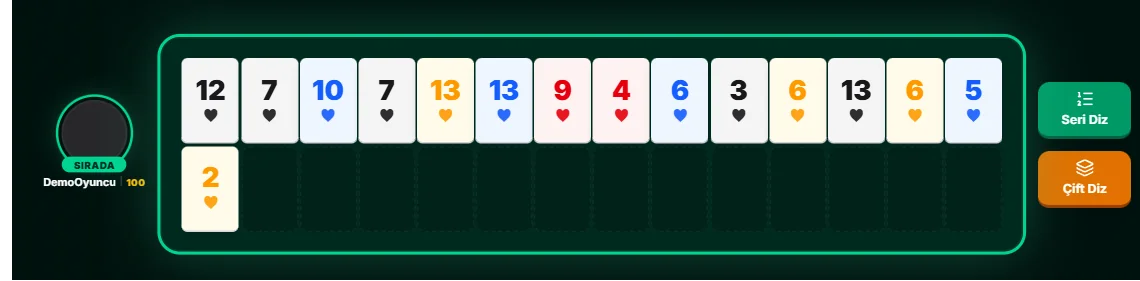
At a four-player table each player is dealt 14 tiles; the starting player gets 15. The tiles are arranged on your rack.
- 2
Check the indicator to find the okey
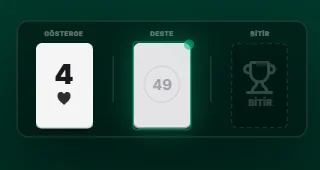
The tile one higher than the face-up indicator, in the same colour, is the okey of that hand. The okey is the joker that can replace any tile in your hand.
- 3
Draw and discard on your turn
When it is your turn, draw one tile from the pile or take the tile discarded by the player on your left, then discard a tile you do not need. That way you always keep 14 tiles.
- 4
Arrange your tiles into sets
Group your tiles into runs (same colour, consecutive) and groups (same number, different colours). Use the okey as a joker wherever a tile is missing.
- 5
Finish your hand
Once all 14 tiles are arranged in valid sets, discard your last tile to finish the hand. Finishing with 7 pairs or by discarding the okey as your last tile scores more points.
Key concepts
The indicator and the okey tile
At the start of each hand an indicator is turned up in the middle. The tile one higher, in the same colour, is the okey of that hand and replaces any tile. If the indicator is 13, the okey is the 1 of the same colour. The indicator itself is not part of play: it stays in the middle throughout the hand and nobody can use it in their sets.
The false okey
The two special tiles without a number are the false okeys. A false okey is not a joker; for that hand it is played in place of the real okey tile. With a black 4 indicator, a false okey is used like a black 5. Mistaking a false okey for an ordinary tile and throwing it early is one of the most common beginner mistakes — when one shows up in your hand, check the indicator to see which tile it stands for.
Sets — runs and groups
Tiles are arranged in two kinds of sets; each set has at least 3 tiles. The 1 is flexible: in runs it can start 1-2-3 or end 12-13-1 — but wrapping around like 13-1-2 is not allowed. In groups, the same number can appear in at most 4 different colours.
Draw from the pile or take the discard?
When it is your turn you have two options. Drawing from the pile is hidden: nobody sees what you took, so nothing about your hand leaks out. Taking the discard — the tile thrown by the player on your left — can strengthen your hand but shows your opponents which tiles you are collecting. Good players save taking discards for tiles that really help; reaching for every shiny tile means telling the table about your hand.
The rack and organising your hand
Your tiles are arranged on the rack in front of you. Experienced players group their tiles by colour and possible runs so they can see at a glance which set each new tile brings them closer to. On miniOkey Web the Sort Series and Sort Pairs buttons group your tiles automatically — no time wasted rearranging. When it is your turn, the frame of your rack lights up green.
Bot players — start without waiting
If you do not want to wait for a table to fill, set up your own table on miniOkey Web and add bots (computer players) to the empty seats — you start playing against three bots instantly. Bot tables are also perfect for beginners to learn the rules without pressure; you can move on to tables full of real players whenever you like.
Finishing the hand
Once all 14 tiles are arranged in valid sets, you finish the hand by discarding your last tile. On miniOkey Web the finishing tile is dropped on the FINISH area in the middle; the game checks your hand automatically and ends the hand if your sets are valid. There are three kinds of finish: a normal finish, a pairs finish with 7 pairs and an okey finish where the okey is the last tile discarded. Pairs and okey finishes score more points.
Scoring
On miniOkey Web every hand of classic okey is a separate match. Every member at the table puts gold worth the table value into the gold pot; the pot holds four times the table value. When the hand ends the pot is shared out like this:
| The player who finishes | takes the pot (3 × table value, minus a 5% site fee) |
| Players who do not finish | lose their entry gold |
| The pile runs out before anyone finishes | everyone gets their entry gold back |
At every table a 5% site fee is deducted from the finisher's winnings (e.g. 712 instead of 750 gold at a 250 table). The finisher also earns 200 XP, the others 50 XP. Guest players do not receive gold or XP. To play the next hand, everyone puts in the table value again.
Hand points by type of finish
When you finish, the screen shows hand points according to how you finished. Finishing with pairs or by discarding the okey doubles the points; doing both quadruples them:
| Normal finish (sets, discarding the last tile) | 2 points |
| Pairs finish (7 pairs) | 4 points |
| Okey finish | 4 points |
| 7 pairs + okey finish | 8 points |
The type of finish affects your hand points and statistics (such as how many okey finishes you have); the gold you take from the pot does not depend on it — the finisher always takes the pot.
Strategy Tips
- Decide in the first few turns whether to build your hand around runs or groups; chasing both at once wastes tiles.
- Keeping the tiles next to the indicator (the okey’s neighbours) in hand also lowers the chance of an opponent finishing with the okey.
- Taking discards lets your opponents read your hand: it shows which run you are collecting. Apart from key tiles, prefer drawing from the pile.
- If you are aiming for a pairs finish, decide early; switching from sets to pairs in the middle of a hand is usually too late.
- Discarding the okey as your last tile scores the most — but if your hand drags on, you may be stuck with it; weigh the risk against your hand.
- When you are close to finishing, do not depend on a single tile: setting up a hand that can finish with two different tiles halves your waiting time.
- At video tables your opponent’s pace is information too: quick moves usually mean a ready hand, long pauses a search for a tile.
Frequently Asked Questions
How is the okey tile determined?
The tile one higher than the face-up indicator tile, in the same colour, is the okey of that hand. For example, if the indicator is red 4, the okey is red 5. If the indicator is 13, the okey is the 1 of the same colour.
What is a false okey?
They are the two special tiles without a number. A false okey stands in for the real okey tile of that hand: with a red 4 indicator, a false okey is played as red 5. It is not a joker.
How many tiles and players are used in okey?
Classic okey is played by 4 players with 106 tiles: two sets of the numbers 1–13 in 4 colours, plus 2 false okeys. Each player gets 14 tiles; the starting player gets 15.
How do you finish a hand?
Once all 14 of your tiles are arranged in valid sets (runs or groups), discard your remaining tile to finish the hand. The first player to finish wins that hand.
Can you finish with pairs?
Yes. If your 14 tiles form 7 pairs you can make a pairs finish. A pairs finish is worth twice the points of a normal finish (4 points); if you also discard the okey as your last tile it is worth 8 points.
What do you get for finishing with the okey?
Finishing by discarding the okey as your last tile is worth twice the points of a normal finish (4 points); together with a pairs finish it is 8 points. But saving the okey for the end can slow your hand down, so it is risky.
What is a set, and how many tiles does it need?
A set is a valid arrangement of at least 3 tiles: consecutive numbers in one colour (a run) or the same number in different colours (a group). The hand is complete when all 14 tiles are arranged in sets.
Is the indicator tile used in the game?
No. The indicator is only turned up to determine the okey of the hand and stays in the middle throughout; no player can take it or use it in their sets.
What is the difference between classic okey and 101 okey?
In classic okey you arrange your 14 tiles into sets and finish by discarding your last tile; sets are not laid on the table. In 101 okey you lay your sets on the table once they pass 101 points, shed your hand by adding tiles, and the match is played with penalty points.
Can I add bots to my table?
Yes. When you set up your own table you can fill the empty seats with as many bots (computer players) as you like. You start playing right away without waiting for the table to fill; playing against bots is also ideal for learning the okey rules.
Can I start a new match at the same table when one ends?
Yes. When the match ends, the "New Game" button starts a new match at the same table with the same settings in one click — no trip back to the lobby. Drawing and discarding happen instantly, so play stays fast and uninterrupted.
Curious about the points-based version where you open your sets on the table? Read How to Play 101 Okey; if you are ready, play okey for free.
Ready? Take a seat
You know the rules — now try them against real players on miniOkey Web, no installation needed.
Play Okey Now