How to Play Pisti
Pisti (Pişti) is a Turkish card game for two players or four in partnerships, played with a 52-card deck. Play a card matching the top of the pile, or a jack, and you take the whole pile; taking a single card with its match is a pisti. Points are counted after each hand and the first to the target wins.
The goal of the game
In Pisti you want to collect valuable cards and as many cards as possible, and score big with pistis. After each hand the aces, jacks, two of clubs and ten of diamonds you took score points, and whoever took the most cards gets 3 more.
The fun is in the timing: deciding when to take a growing pile, which pile is worth your jack, and how to avoid giving your opponent a pisti. Players who remember which ranks have been played are always a step ahead.
Pisti is one of Turkey’s favourite card games; close relatives are Xeri in Greece and Basra in Arab countries. On miniOkey you can play one on one or four players in partnerships.
Cards and dealing
Pisti uses 52 cards: spades, hearts, diamonds and clubs, 13 each, no jokers. At the start of a hand 4 cards go to the table: three face down and the top one face up. If that card is a jack it is shuffled back into the deck and a new one is turned up.
Everyone gets 4 cards. When all hands are empty, four more each until the deck runs out: a hand lasts 6 deals with two players and 3 deals with four. The player after the dealer starts.
Card ranking does not matter in Pisti: to capture you only need the same rank (7 on 7) or a jack. Suits do not matter either.
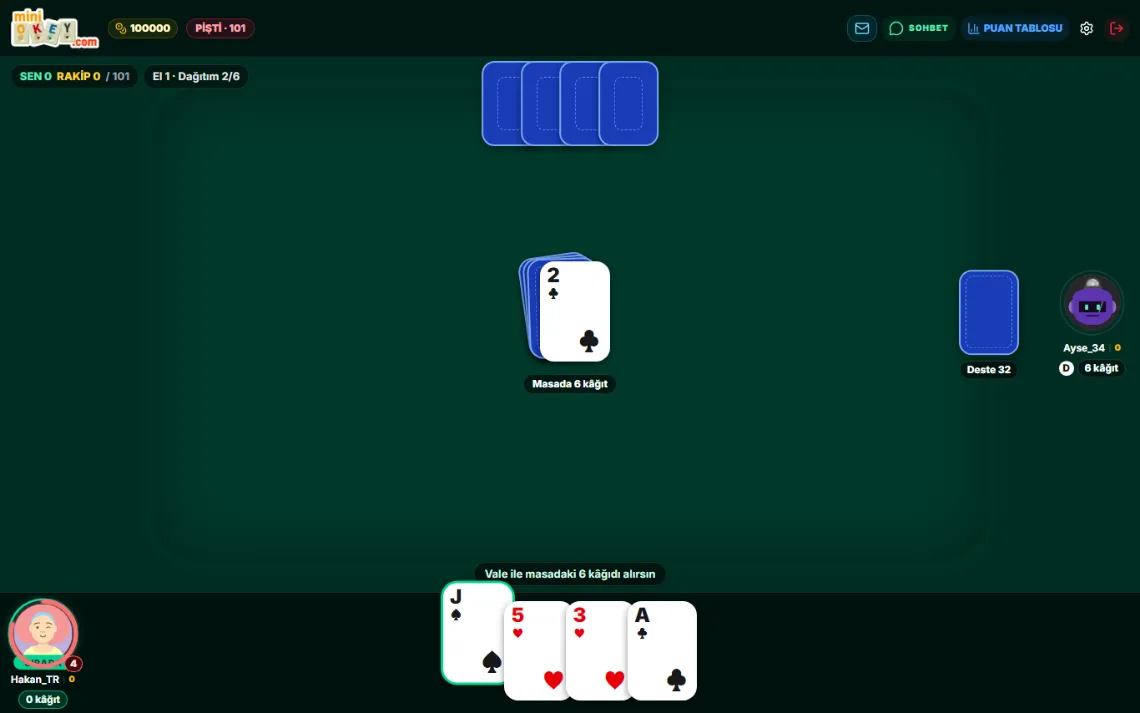
How to play Pisti step by step
- 1
Four cards go to the table
Four cards are placed on the table: three face down and the top one face up. If the face-up card is a jack, it goes back into the deck and a new one is turned.
- 2
Everyone gets four cards
Each player gets four cards. The player after the dealer starts.
- 3
Play a card in turn
On your turn you play one card from your hand. Any card may be played; there is no need to follow suit or play higher.
- 4
Take the pile
If your card matches the rank of the top card, or it is a jack, you take the whole pile. Taking a single card with its match is a pisti.
- 5
Deal again
When everyone’s hand is empty, four more cards each are dealt until the deck runs out.
- 6
Score the hand
When the deck runs out, the cards left go to the last player who took a pile. Aces, jacks, the two of clubs, the ten of diamonds, most cards and pistis score.
- 7
End of the match
Points add up after every hand. The first player or team to reach the target (101 or 151) wins.
Basic rules and terms
Taking the pile: matching rank
If your card has the same rank as the top card of the pile you take every card on the table, however many there are, including the face-down ones. Suits do not matter: the nine of clubs takes the nine of hearts.
If you cannot capture, your card goes on top and becomes the new top card. On miniOkey the cards that can take the pile light up and we show how many cards you would take.
The nine of hearts is on top; play the nine of clubs and the whole pile is yours.
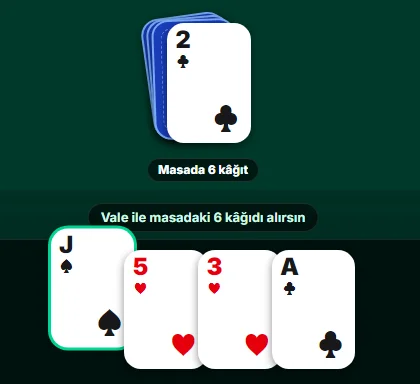
The jack takes everything
A jack takes the whole pile whatever is on top. That makes it the most valuable card in the game: save it for a big pile or one holding scoring cards.
Playing a jack on an empty table takes nothing; it simply starts the new pile. If your opponent still holds a jack, they can use it for a jack pisti, so be careful.
The queen of diamonds is on top and you have no queen, but your jack takes the pile.
What is a pisti?
Taking a single card on the table with a card of the same rank is a pisti worth 10 points. Taking a single jack with a jack is a jack pisti: 20 points.
Taking a single card with a jack is not a pisti: you get the cards but no pisti points. On miniOkey a big "PİŞTİ!" appears on the table and the points are added at once.
Only the seven of diamonds is on the table; take it with the seven of spades for a pisti.
A single jack of hearts on the table; taking it with the jack of clubs scores 20.
You take the single seven with a jack, but it does not count as a pisti.

Scoring cards
At the end of a hand your captured cards are counted: every ace and jack scores 1, the two of clubs 2 and the ten of diamonds 3. Each hand holds 13 points in cards: four aces, four jacks, the two of clubs and the ten of diamonds.
The ten of diamonds and the two of clubs are valuable on their own; when you see one in the pile it can be worth spending your jack.
Most cards (3 points)
Whoever collects the most cards in a hand gets 3 more points. On a tie (26–26 with two players) nobody does, so taking small piles often pays off too.
The last cards
When the deck is empty and the last card has been played, the cards left on the table go to the last player who took a pile. If nobody took a pile in that hand, they go to the dealer.
This makes the last deal important: keep a jack for the end and you may take the last pile and the leftovers.
Partnership Pisti
Choose four players (partners) when creating a table and the two players sitting opposite form a team. The rules stay the same; the partners’ cards, pistis and points add up and most cards is counted per team.
With four players a hand lasts 3 deals. Leaving a pile your partner can take matters as much as not giving your opponents a pisti.
Scoring: cards, pistis and end of the match
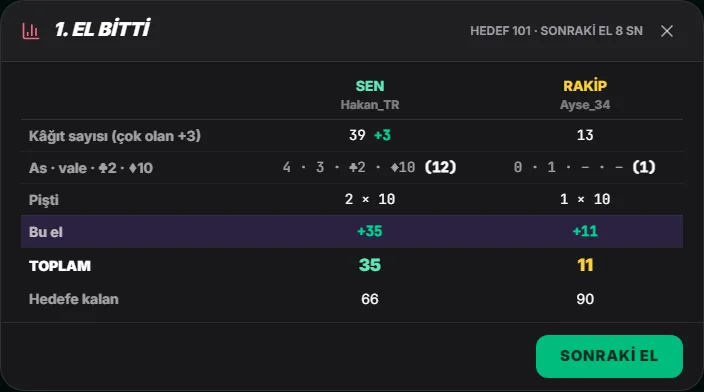
At the end of every hand the captured cards are counted. On miniOkey scoring is fully automatic: the end-of-hand table shows the card count, aces · jacks · two of clubs · ten of diamonds, pistis, points for the hand, the total and the points left to the target.
Card points
| Each ace | +1 |
| Each jack | +1 |
| Two of clubs | +2 |
| Ten of diamonds | +3 |
Pistis and card count
| Pisti (single card taken with its match) | +10 |
| Jack pisti (jack on a single jack) | +20 |
| Most cards (nobody on a tie) | +3 |
Example hand
| You — cards 12 + most cards 3 + 2 pistis 20 | +35 |
| Opponent — 1 jack 1 + 1 pisti 10 | +11 |
End of the match and gold
The table creator picks the target: 101 or 151. The first to reach it at the end of a hand wins; if both pass it in the same hand the higher score wins, and on a tie one more hand is played. At a two-player table the winner gets their own entry back plus the opponent’s (minus a 5% site fee); in partnerships both winners share the prize.
Strategy Tips
- Don’t waste your jack: keep it for a big pile or one holding the ten of diamonds or the two of clubs.
- A card played on an empty table is a pisti chance for your opponent: play ranks that have mostly been seen.
- Remember which ranks have been played; a rank with all four seen is safe to put down.
- Keeping a jack for the last deal can win you the last pile and the leftover cards.
- In partnerships leave piles your partner can take, never a single card your opponents can snap.
Frequently Asked Questions
How many players does Pisti need?
Pisti is played by two players head to head or four in partnerships. On miniOkey you choose two players or four (partners) when creating a table; in partnerships the players sitting opposite are a team and score together. If seats are empty, add a bot and start right away.
How many points are a pisti and a jack pisti?
Taking a single card on the table with a card of the same rank is a pisti and scores 10 points. Taking a single jack by playing another jack is a jack pisti worth 20 points. Taking a single card with a jack is not a pisti; you get the cards but no pisti points.
What does the jack do?
A jack takes the whole pile whatever the top card is, which makes it the most valuable card in Pisti. It is wise to save it for a pile with many cards or with scoring cards like the ten of diamonds or the two of clubs. A jack played on an empty table takes nothing.
Which cards score how many points?
At the end of a hand every ace and every jack scores 1, the two of clubs 2 and the ten of diamonds 3. Whoever collected the most cards in that hand gets 3 more points; on a tie nobody does. Points from pistis, 10 and 20, are added on top.
Who gets the cards left at the end?
When the last card has been played, the cards still on the table go to the player or team that last took a pile in that hand. If nobody took a pile, they go to the dealer. That is why keeping a jack for the last deal can win you the last pile and the leftovers.
What if the first face-up card is a jack?
If the face-up top card of the four cards turned at the start of a hand is a jack, it is shuffled back into the deck and a new card is turned instead. That way nobody starts with a free jack pisti chance; the three face-down cards below go to whoever takes the pile first.
When does a Pisti match end?
The table creator chooses a target of 101 or 151 points. Points are added after every hand and the first to reach the target wins. If both sides pass it in the same hand the higher score wins, and on a tie one more hand is played. To avoid endless matches, at most 15 hands are played.
What happens if my time runs out?
Every turn lasts 30 seconds, with one 30-second extension if needed. If that runs out too, the game plays for you: it takes the pile with a matching card if it can, otherwise it keeps your jacks and plays your least valuable card. The table never waits for anyone.
Know the rules now? Play Pisti for free. We have more card games too: read How to Play Batak and How to Play Spades.
Ready? Take a seat
You know the rules — now try them against real players on miniOkey Web, no installation needed.
Play Pisti Now