How to Play Spades
Spades is a trick-taking card game for four players in two partnerships, played with a standard 52-card deck. Spades are always trump. Every player bids how many tricks they will take, partners try to make their combined contract together, and the first team to reach the target score wins.
The goal of the game
In Spades the two players sitting opposite each other are partners and points go to the team. At the start of every deal each player says how many tricks they can take; the partners’ bids add up to the team contract. Make the contract and the team scores; fall short and it loses points.
A good Spades player both judges their hand well and plays in tune with their partner: a trick your partner takes counts for you too. Taking too many is risky as well, because extra tricks pile up as bags and ten bags cost the team a penalty. The aim is to take exactly what you promised — not less, not much more.
If you know Batak you will pick up Spades in a few deals, but the rules are not identical: there is no trump choice, no auction, no obligation to beat the highest card and no obligation to trump. This guide shows every difference.
Cards, teams and dealing
Spades uses 52 cards: spades (♠), hearts (♥), diamonds (♦) and clubs (♣), 13 cards each, no jokers. Every player gets 13 cards, the whole deck is dealt and each deal has 13 tricks.
Players sitting opposite each other form a team: you and the partner across the table against the two opponents on your left and right. On miniOkey your partner is marked PARTNER at the top of the table. The dealer moves on each deal; bidding and the first lead start with the player to the dealer’s right.
Card ranking (high to low): A (Ace) › K (King) › Q (Queen) › J (Jack) › 10 › 9 › 8 › 7 › 6 › 5 › 4 › 3 › 2 — spades are always trump
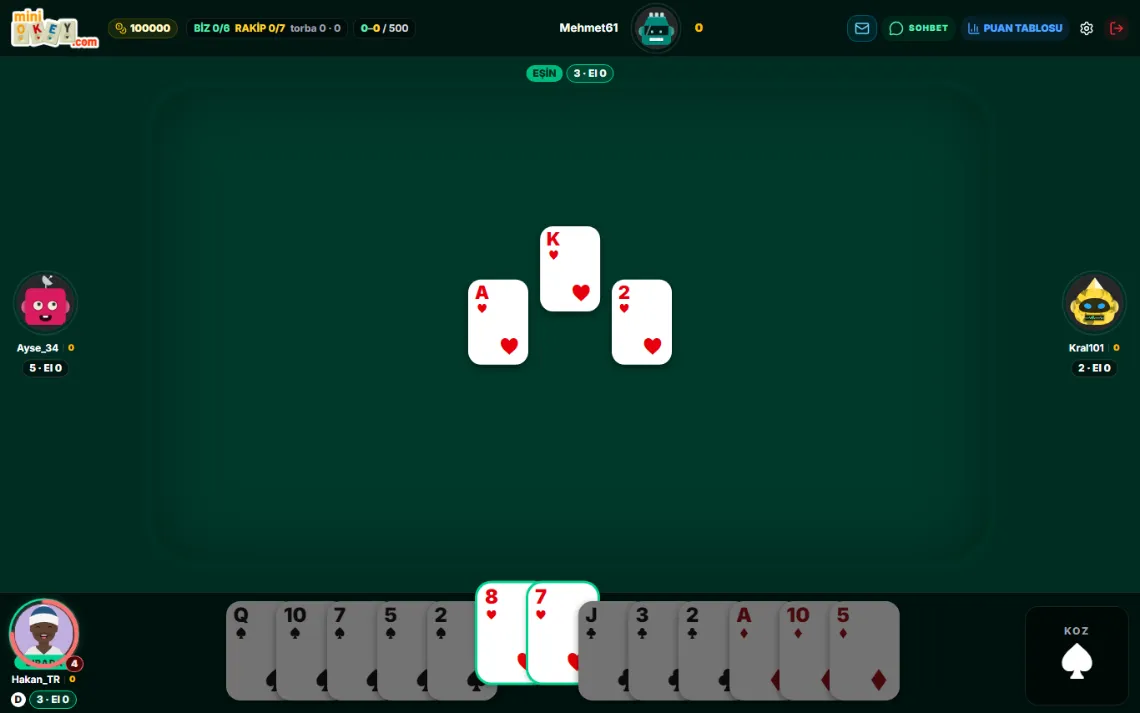
How to play Spades step by step
- 1
The cards are dealt
Everyone gets 13 cards. Look at your hand and count how many tricks your aces, guarded kings and spades can take.
- 2
Everyone bids
Starting with the player to the dealer’s right, everyone bids once a number from 0 to 13. There is no passing and no raising; a bid of 0 is NIL, a promise to take no tricks.
- 3
The team contract is set
Partners’ bids add up to the team contract. A NIL bid is not added. Nobody picks trumps: spades are always trump.
- 4
The first card is led
The player to the dealer’s right leads the first card. Spades are not broken yet, so they cannot lead a spade while they hold another suit.
- 5
Tricks are played
Everyone plays one card in turn. You must follow suit; without it you may play any card. The highest spade, or else the highest card of the led suit, wins the trick and leads next.
- 6
Points are scored
After 13 tricks each team counts its tricks. A team that makes its contract scores contract × 10 plus its extra tricks, a team that fails loses contract × 10; NIL and bags are scored separately.
- 7
End of the match
Deals continue until a team reaches the target score (250 or 500). The first team to reach it wins; a team that falls to −200 loses.
Basic rules and terms
What is a bid and how is the team contract formed?
Your bid is your promise of how many tricks you will take in this deal. Unlike Batak there is no auction: everyone bids once when it is their turn, any number from 0 to 13 is allowed and nobody passes.
If your partner has already bid, their number is shown on the panel so you can decide accordingly. The two partners’ bids add up to the team contract. If you bid 4 and your partner 3, your team needs 7 tricks — it does not matter which of you takes them.
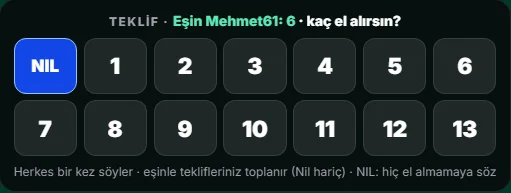
NIL: promising no tricks
Bidding 0 means NIL: you promise not to take a single trick in this deal. Made, your team gets +100; take even one trick and it is −100. A NIL bid is not added to the team contract; your partner’s bid alone forms the contract.
Tricks taken by the NIL bidder do not count toward the partner’s contract; they become bags. If your partner bids NIL, protect them by winning tricks with your high cards; if an opponent bids NIL, lead suits that force them to take a trick.
Spades are always trump
In Spades nobody picks trumps: in every deal spades (♠) are trump. Even the lowest spade beats an ace of another suit; between two spades the higher one wins. On miniOkey a large spade sits bottom right as a permanent trump indicator.
The ace of diamonds is led and you have no diamonds: trump with the 2 of spades and you win the trick. You may also discard the king of clubs instead — trumping is optional.
Following suit: no obligation to beat or to trump
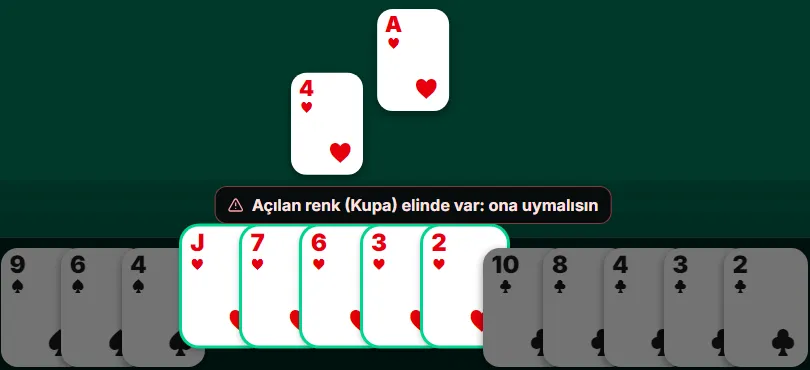
If you hold the led suit, you must play that suit. Unlike Batak, you do not have to beat the highest card on the table; any card of that suit is fine.
Without the led suit you may play any card: trump with a spade or discard another suit and let the trick go. There is no obligation to trump. miniOkey dims cards you cannot play and tells you why if you tap one.
The queen of hearts is on the table and you hold the 3 and the king of hearts: you may play either. If your partner is winning the trick, the low card is usually right.
Spades cannot be led until broken
Until the first spade has been played, nobody may lead a new trick with a spade. Once a player trumps with a spade because they are out of the led suit, spades are broken and may be led from then on. A player holding only spades may lead one even if spades are not broken.
Who wins the trick?
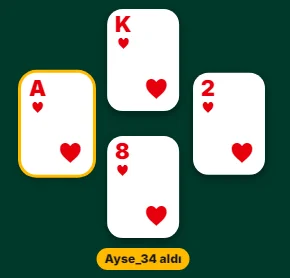
A trick is complete when four cards are played. If it contains a spade, the highest spade wins; otherwise the highest card of the led suit wins. Cards of other suits can never win, however high. The winner leads the next trick and the trick counts for their team.
Bags: the cost of overtricks
Every trick a team takes beyond its contract is a bag. Each bag is worth 1 point, but bags accumulate across deals: when a team reaches 10 bags it loses 100 points and the counter drops by 10. miniOkey shows your bags in the team box at the top and in the end-of-deal table.
That is why making your contract exactly is best in Spades. Underbidding and taking extra tricks deal after deal comes back as a −100 penalty.
Spades vs. Batak
Spades is the partnership member of the Batak family played by international rules. Spades are always trump and never chosen; there is no auction, everyone bids once; points go to the team. You never have to beat the highest card or trump when out of a suit.
Partnership Batak on miniOkey is Batak with bidding played in teams: the auction, the trump choice and the obligation to beat the highest card all stay. Want to try both? Create a pairs table on the Batak page.
Scoring: contract, NIL and bags
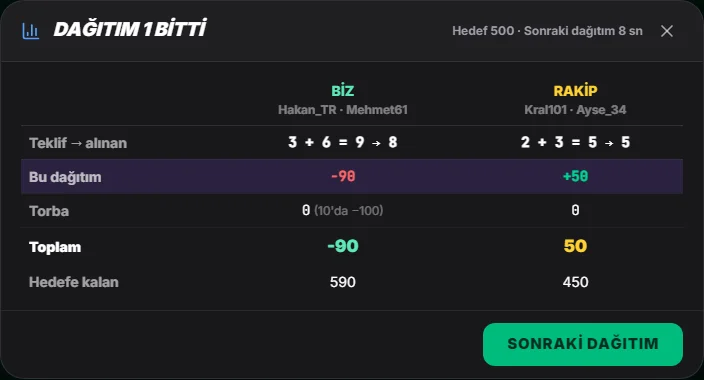
At the end of every deal each team counts its tricks. On miniOkey scoring is fully automatic: the end-of-deal table shows both teams’ bids, tricks taken, points for the deal, bags and the points left to the target.
Team contract
| Contract made (bid or more tricks) | contract × 10 |
| Each trick above the contract (bag) | +1 |
| Contract failed | contract × −10 |
NIL and bags
| NIL made (no tricks taken) | +100 |
| NIL broken (at least one trick) | −100 |
| When bags reach 10 | −100 |
Example deal
| Us — contract 7, 9 tricks (made, 2 bags) | +72 |
| Them — contract 5, 4 tricks (failed) | −50 |
End of the match and gold
The table creator picks the target: 250 for a short match, 500 for classic Spades (500 by default). The team that reaches the target at the end of a deal wins; if both pass it in the same deal the higher score wins, and on a tie one more deal is played. A team that falls to −200 loses. Both players of the winning team share the gold prize.
Strategy Tips
- Count sure tricks when you bid: aces, guarded kings and a long run of spades are the most reliable. A short side suit can also give you a trick by trumping.
- Watch your partner’s bid: if they bid high, stay careful and keep the team total from going over 13.
- Once your contract is made, avoid extra tricks; bags pile up and bring a −100 penalty.
- If your partner bids NIL, protect them by winning tricks with your high cards. If an opponent bids NIL, lead suits that force them to win a trick.
- Keep track of which spades and high cards have been played; knowing who can still trump decides the last tricks.
Frequently Asked Questions
How many players does Spades need?
Spades is played by four players in two teams: partners sit opposite each other and points go to the team. On miniOkey you can create a table and fill empty seats with bots, so you can start right away with a partner or with bots without waiting. Both winners share the prize.
What is the difference between Spades and Batak?
In Spades, spades are always trump and never chosen, there is no auction — everyone bids once — and points go to the team. Unlike Batak, you never have to beat the highest card or trump when you are out of a suit. NIL bids and the bag penalty exist only in Spades.
What is NIL and how is it scored?
NIL means bidding 0: you promise not to take a single trick in that deal. Take none and your team scores +100; take even one and it is −100. A NIL bid is not added to the team contract, and tricks the NIL bidder takes do not count for the partner — they become bags.
What are bags and when do they cost points?
Every trick a team takes above its contract is a bag worth 1 point. Bags accumulate from deal to deal; when a team reaches 10, it loses 100 points and the counter drops by 10. Making your contract exactly is therefore better than regularly taking extra tricks.
Can I lead a spade before spades are broken?
No. Until the first spade has been played you cannot lead a new trick with a spade, unless you hold nothing but spades. As soon as a player trumps with a spade because they are out of the led suit, spades are broken and anyone may lead them from then on.
Do I have to trump if I cannot follow suit?
No. In Spades, if you do not have the led suit you may play any card: trump with a spade to win the trick, or discard a low card of another suit and let it go. If you do have the led suit you must follow, but you never have to beat the highest card.
When does a Spades match end?
The table creator chooses a target of 250 or 500 points; 500 is the default. The team that reaches it at the end of a deal wins, and if both pass it the higher score wins. A team that falls to −200 loses. To avoid endless matches, at most 25 deals are played.
What happens if my time runs out?
Every turn lasts 30 seconds, with one 30-second extension if needed. If that runs out too, a bid of 1 is made for you during bidding, and during play your lowest legal card is played, keeping spades when possible. The table never waits for anyone and the game keeps flowing.
Know the rules now? Play Spades for free. For Batak with bidding and partnership Batak read How to Play Batak, for the tile games How to Play Okey.
Ready? Take a seat
You know the rules — now try them against real players on miniOkey Web, no installation needed.
Play Spades Now