Turkish Backgammon (Tavla): How the Rules Differ and Why It Matters
Also available in: Türkçe · Deutsch
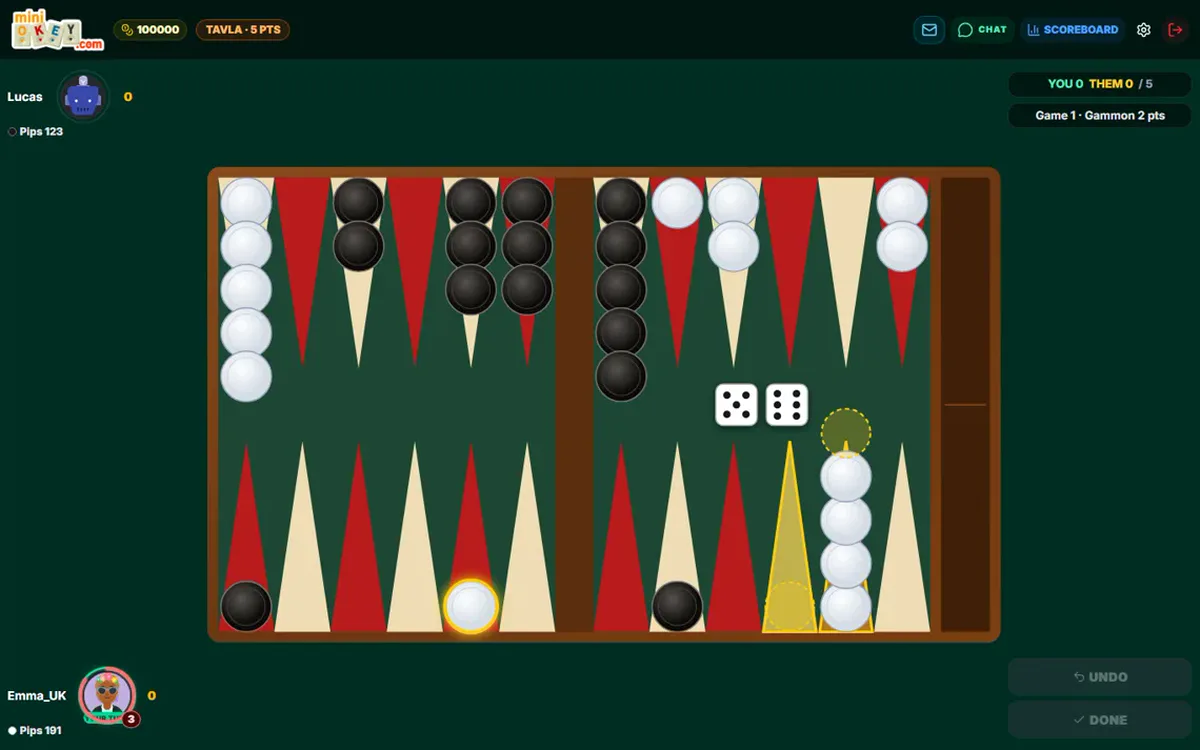
If you know backgammon, you already know how to move in tavla. What you need to relearn is the scoring: no doubling cube, no triple game and a different opening roll. Here is what that does to your decisions.
Sit down at a tavla board in an Istanbul café and the first few moves will look completely familiar: same board, same starting position, same hitting and bearing off. The differences show up at the opening roll and grow at the end of the game. Turkish tavla is backgammon played with a simpler, older-style scoring system, and that simplicity changes how you should play. The full rules are in our how to play backgammon (tavla) guide; this post is about what the differences mean at the board.
Where do the rules differ?
Put Turkish tavla next to international tournament backgammon and its closest Greek relative, Portes, and the differences come down to a handful of points:
| Rule | Tavla | Backgammon | Portes |
|---|---|---|---|
| First move | Winner re-rolls both dice | Plays the two opening dice | Re-rolls |
| Doubling cube | None | Yes | None |
| Opponent bore off nothing | 2 points | 2× (gammon) | 2 points |
| …with a checker on the bar or in your home | Still 2 | 3× (backgammon) | Still 2 |
| Hit-and-run at home | Allowed | Allowed | Not allowed |
The last row deserves a note. In some Turkish and Greek games a checker that hits in its own home board must stay there for the rest of the turn; written sources list this restriction for Turkish tavla too. It is not applied everywhere, and on miniOkey there is no such restriction: you may hit at home and keep moving the same checker. If you join a game in a Turkish café, ask before the first roll.
In Turkish the gammon is called mars, and you will hear it shouted across the café when it happens. Our game shows it on the scoreboard as "Gammon 2 pts".
What changes without a doubling cube?
In international backgammon a player may, before rolling, offer to double the value of the game. The opponent either accepts and owns the cube, or refuses and loses the game at its current value. The stakes can climb to 2, 4, 8 and beyond.
The biggest effect of the cube is that hopeless games end early: the player who has fallen far behind usually refuses the double. Tavla has no such exit, so every game is played to the end. That has two consequences:
- Comebacks are worth more. A single hit during your opponent’s bear-off can still turn a game that looks lost. Positions that would be dropped in backgammon are played out in tavla.
- The only extra loss to think about is the gammon. With no take-or-drop decisions, your risk management is simple: once you know you will lose, make sure you bear off at least one checker and keep the loss to 1 point.
No triple game: why risk is cheaper
In backgammon, losing without bearing off is a gammon (2×), and if you still have a checker on the bar or in the winner’s home board it is a backgammon (3×). Multiplied by the cube, a single game can be worth 8 or even 12 points. In Turkish tavla the worst case is always 2 points.
That changes the price of aggressive play. Hitting your opponent and closing points in your home board is strong in both games. But in backgammon the player who has been blitzed and is waiting on the bar risks a triple loss; in tavla the same player can lose no more than 2. A player who is behind in tavla can afford to hold an anchor in the opponent’s home board and wait for a late shot, because the downside does not grow.
International rules also have an optional Jacoby rule for money play: if nobody has doubled, gammons and backgammons count as a single game. Tavla does not need such an exception; without a cube, a gammon is simply 2 points.
The opening roll: one die each, or a re-roll?
Under international rules each player rolls one die, and the higher roller plays those two numbers as the first move. Ties are re-rolled, so the first move can never be a double. In Turkish tavla the higher roller picks up both dice and rolls again, so the first move can be double sixes or double ones. With the re-roll, the opening move is a double one time in six (16.7%).
The second difference is who starts the following games. In backgammon each new game begins with a fresh opening roll. At miniOkey’s Turkish-rules tables the winner of the previous game starts the next one, a habit that varies from table to table in Turkey. Starting first is a small but real edge, and a player on a winning streak keeps it.
Greek tavli: three games in a cycle
In Greece "tavli" is not one game but three played in turn: Portes, Plakoto and Fevga, cycling until someone reaches the target, usually 5 or 7 points. Portes is almost identical to Turkish tavla. Plakoto is a pinning game, where landing on a single opposing checker traps it instead of hitting it, and Fevga is a running game in which both players move in the same direction. Turkish tavla corresponds to Portes only. On miniOkey Turkish rules are the default and international backgammon can be chosen when you open a table; Plakoto and Fevga are not available.
- On the opening, re-roll both dice: the first move can be a double.
- No cube: play lost-looking games to the end and watch for a late shot.
- If you are losing, bear off at least one checker: a gammon costs 2.
- No triple game: holding an anchor in your opponent’s home board is cheaper.
- At a café table, ask about hit-and-run at home before you start; on miniOkey it is allowed.
- Going back to backgammon: remember the cube, the gammon and the 3× backgammon.
Myth: Tavla and backgammon are different games.
Fact: They are the same game: board, setup, hitting and bearing off match. The differences are the opening, the scoring and the cube.
Myth: Turkish tavla has a triple game too.
Fact: It does not. Even with a checker left on the bar, the most you can lose is 2 points (mars).
Myth: The first move can never be a double.
Fact: True in international backgammon. In tavla the dice are re-rolled, and one opening in six is a double.
Knowing both rule sets helps in both games: backgammon’s arithmetic teaches you to read risk, and tavla’s play-it-to-the-end habit teaches patience. To try a match under Turkish or international rules, open a table from our play backgammon page; matches run to 3, 5 or 7 points.