Okey, the Turkish Rummy: Where It Comes From and How It Differs from Rummikub
Also available in: Türkçe · Deutsch
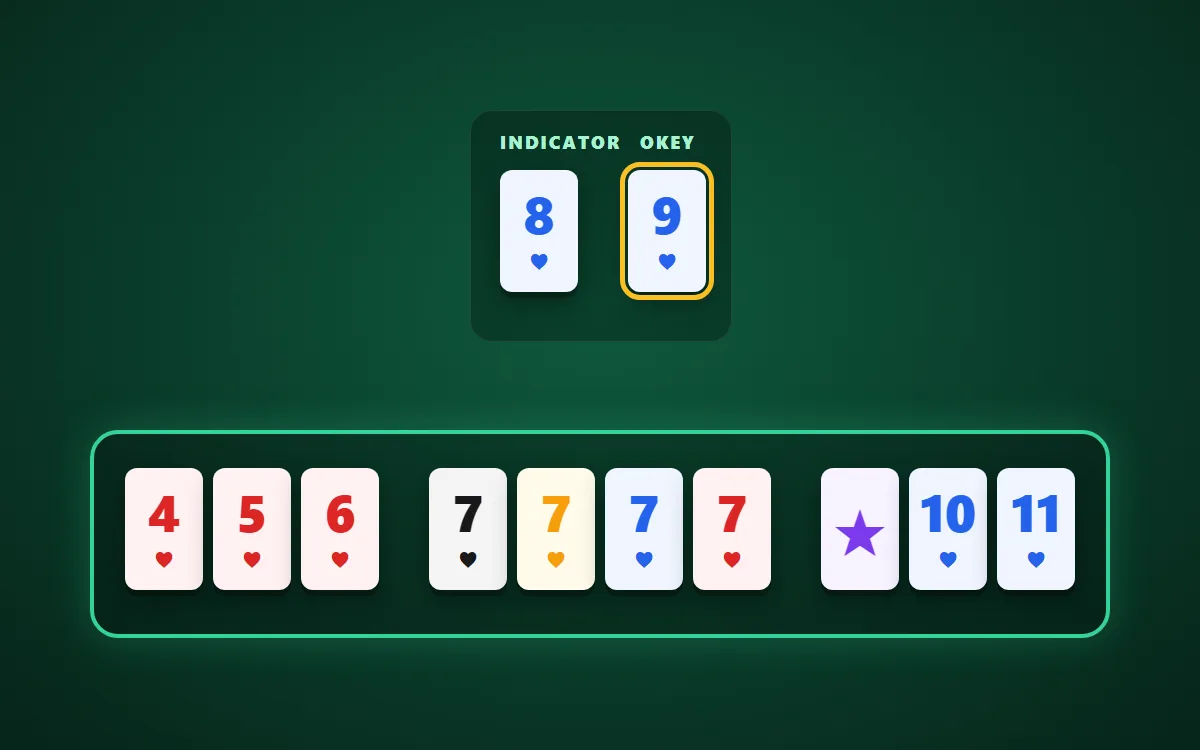
If you have played Rummikub, an okey set will look instantly familiar. The game is not. Here is where okey sits in the rummy family, what we know about its history and what makes it different.
Walk past a Turkish tea garden on a summer evening and you will hear the click of tiles on wooden racks. That is okey, one of the most played table games in Turkey. Visitors who know Rummikub often think they have seen it before: the same coloured tiles numbered 1 to 13, the same runs and groups. Then they sit down and discover that almost everything that matters works differently. The step-by-step rules are in our how to play okey guide; this post is about where the game comes from and what sets it apart.
Do we know when okey was invented?
No. The card and tile game references describe okey’s rules in detail: 104 tiles numbered 1 to 13 in four colours, two of each, plus two false okeys, 106 tiles in all, and a joker chosen anew every hand by an indicator tile. None of them gives a date or place of origin. Stories that begin "okey was invented in such-and-such a year" have no source behind them, so we will not repeat any.
What we can say is where okey belongs: it is the Turkish tile member of one of the largest card game families in the world, rummy.
The rummy family: games of melds
In rummy games the aim is to arrange your cards or tiles into melds: the same number in different colours (a group) or consecutive numbers in one colour (a run). Pagat, the card game encyclopaedia, writes that rummy games seem to be ultimately of Chinese origin and were unknown outside East Asia until the twentieth century. It names the Conquian group as possibly the ancestor of all Western rummy games, and lists mahjong among the Eastern rummy games.
The same source lists okey as a relative played in Turkey with numbered tiles, next to Romanian tile rummy. In Turkey the card-based cousins are familiar too: konken and remi. Okey takes the same idea of building melds and moves it from cards to tiles on a rack.
Rummikub and okey: same tiles, different game
Okey’s best-known relative abroad is Rummikub. According to Wikipedia, it was developed by Ephraim Hertzano, who was born in Romania and emigrated to Israel after the Second World War; he and his family made the first sets by hand in the backyard of their home. The game was marketed in the 1950s, reached the United States in the 1970s, became one of its best-selling games by 1977 and won Germany’s best-known game award, the Spiel des Jahres, in 1980.
The tile sets are almost identical: four colours, numbers 1 to 13, two of each, and two special tiles. The way the games flow is not:
| Rule | Okey | Okey 101 | Rummikub |
|---|---|---|---|
| Tiles in hand | 14 (starter 15) | 21 (starter 22) | 14 |
| Joker | Changes every hand | Changes every hand | Two fixed jokers |
| Melds | Stay on your rack | Laid down from 101 | On the table, shared |
| A turn | Draw, discard | Draw, meld, add, discard | Play tiles or draw |
We found no dated evidence that one game came first or grew out of the other. The Wikipedia article on Rummikub mentions okey as a Turkish variant, but the source behind that sentence is thin, and the article on okey makes no such claim. The fairest description is two games from the same family, played with very similar tiles.
What makes okey different: the changing joker
Okey’s most original idea is that the joker changes every hand. At the start, a tile is turned face up as the indicator; the tile of the same colour and one number higher is that hand’s okey. If the indicator is a blue 8, the okey is the blue 9. The two false okeys in the set are not jokers in their own right: they simply stand in for the tile that has become the okey. In Rummikub the jokers are fixed; in okey the joker is decided again with every deal, and each hand becomes a small puzzle.
The other big difference is that in plain okey your melds never leave your rack. You draw a tile, from the pile or from the discard of the player on your left, and throw one away, until all fourteen tiles form complete melds and you can finish. Nobody sees your hand until you go out.
Where does the name of 101 come from?
Okey’s most popular sibling, okey 101, gets its name from its opening rule: the first time you lay melds on the table, their total value must be at least 101. Pagat explains the name the same way. Unlike plain okey, melds in 101 are laid down and other players can add tiles to them, which brings it closer to the card games of the rummy family. Scoring is a penalty count: failing to open costs 202 points. The full rules are in our okey 101 guide.
A few Turkish words you will hear at the table
- Gösterge: the indicator tile that decides the okey.
- Okey: the joker of the hand; also the name of the game.
- Sahte okey: the false okey, the star-marked tile that stands in for the okey.
- Istaka: the wooden rack where you arrange your tiles.
- Per: a meld. The word comes from the French *paire*, "pair", even though a meld has at least three tiles.
- Çift: a pair. Finishing with seven pairs is a special way to go out.
Myth: We know the year okey was invented.
Fact: We do not. References describe the rules, but none gives a dated origin.
Myth: Okey is just Rummikub with a different name.
Fact: The tiles are almost the same, the game is not. Okey’s joker changes every hand, and in plain okey melds stay on your rack instead of going on the table.
Myth: The false okey is a joker.
Fact: It is not. It only stands in for the tile that is the okey in that hand; the real joker is the okey tile.
Myth: 101 is played with 101 tiles.
Fact: The set has 106 tiles. The name comes from the minimum value of 101 needed to open.
Okey’s inventor may never be known, but every hand starts a new story: you turn the indicator, learn which tile is the joker and build your plan from there. To try it against real players or bots, open a table from our play okey page.