The History of Spades, and Its Turkish Cousin Batak
Also available in: Türkçe · Deutsch
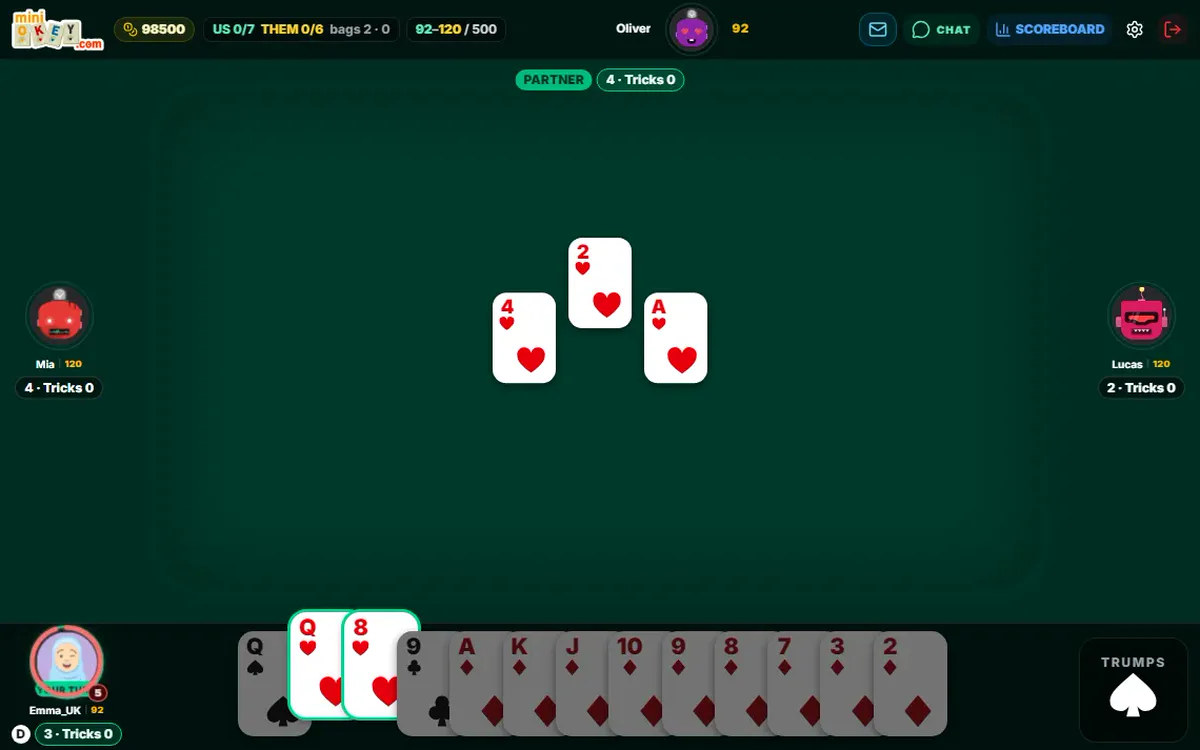
Spades has a surprisingly well-documented birthplace and a clear path around the world. Its Turkish cousin Batak, played at the same kind of table, has no recorded origin at all. Here are both stories, with sources.
Spades players and Batak players would recognise each other’s tables at once: four players, thirteen cards each, a number said out loud before the first card is played, and then a hand spent keeping that promise. The likeness is no accident; both games are branches of the largest family of trick-taking games, the whist family. Their histories, though, are documented very differently. We know roughly where and when Spades was born. Batak has no birth certificate at all.
Where did Spades come from?
Pagat, the card game encyclopaedia, states simply that Spades was invented in the USA in the 1930s. Wikipedia is more specific: the game was devised in the Midwest of the United States in the late 1930s, and the bridge author George Coffin traced its origin to Cincinnati, between 1937 and 1939.
Its structure explains why it caught on. Spades keeps the core of whist and bridge (follow suit, trumps win, partners score together) but replaces bridge’s long auction with something far simpler: spades are always trumps, and every player just names the number of tricks they expect to take. Wikipedia describes it as looking like a simplification of contract bridge.
How did Spades spread around the world?
The game’s rise to popularity in the United States came during the Second World War, when soldiers carried it around the globe. After the war, the GI Bill, which helped veterans go to college, brought it to university campuses and from there into home games.
For a long time Spades remained little known outside the US. Pagat notes that the exceptions were places where American troops were stationed, such as parts of Germany. Pagat also describes a version widely played by African Americans that uses two jokers and the two of spades as extra high trumps.
The real international breakthrough came with the internet. According to Pagat, since the mid-1990s Spades has become popular worldwide because it was so easy to find in online card rooms.
The whist family behind both games
Whist-family games are played by following suit, with the highest card or a trump winning the trick. Pagat calls them a good introduction to trick-taking, but argues they cannot be the oldest trick-taking games: the ace was promoted above the king later, and the idea of trumps was probably borrowed from tarot games.
The most fruitful addition of the last two centuries, Pagat writes, has been bidding: players say how many tricks they will take before play begins. Bidding games split into two groups. In one you must take at least the number you bid (Auction Whist, Boston). In the other you must take exactly that number, no more (Oh Hell). Relatives of the family are played all over the world: Hokm in Iran, Court Piece (Rang) in India and Pakistan, Rússi in Iceland, Omi in Sri Lanka.
Batak: Turkey’s cousin with no recorded birthday
In Turkey the best-known game of this family is Batak. We found no reference that dates its origin. Pagat has no page of its own for Batak; its list of Turkish card games describes it only as a four-player game similar to Oh Hell. The origin stories found online cite no sources.
The Turkish Language Association’s dictionary defines Batak as a card game in which a player predicts, from the cards in hand, how many tricks they will win and tries to win at least that many. That "at least" matters: in the version played on miniOkey, taking as many tricks as you bid or more counts as making it, which puts this form of Batak closer to the first bidding group above.
Spades and Batak side by side
The two games start from the same rules, but bidding and trumps turn them into very different games. The table compares the rules used on miniOkey:
| Rule | Batak | Spades |
|---|---|---|
| Trumps | Chosen by the auction winner | Always spades |
| Bidding | Auction: highest bid wins | Everyone bids once (0–13) |
| Who scores? | Each player (or team in pairs) | Always the team |
| Extra tricks | Every trick scores | Bags: 10 bags cost 100 |
| Zero tricks | No tricks at all: −50 | NIL: +100 if made, −100 if not |
| End of match | Fixed number of deals (3–11) | Target score (250 or 500) |
The biggest difference is the trump suit. In Batak the auction winner names trumps, so the bidding is a fight for control; in Spades the trump suit is fixed from the start and the game is about the team making its combined bid. The full rules are in our Spades guide and Batak guide.
Turkish words at the Batak table
If you sit down with Turkish players, you will hear these words. The origins come from the Turkish Language Association’s dictionary:
- Koz: trumps. From Persian *gavz, goz*.
- İhale: the bid, and the auction to decide who leads the hand. From Arabic *iḥāle*; in everyday Turkish it also means a public tender.
- Pas: pass, from French *passe*.
- Maça: spades, from Italian *mazza*.
- Batak: the dictionary gives no origin. A link with the verb *batmak*, "to sink", seems natural, since a player who fails the bid is said to have "sunk", but we found no source that confirms it.
Myth: Spades is just the American name for Batak.
Fact: They are two different games. In Spades, spades are always trumps and there is no auction; in Batak the auction winner chooses trumps.
Myth: Batak came from Spades, or the other way round.
Fact: Both are branches of the whist family; there is no dated evidence that one grew out of the other.
Myth: Spades is a centuries-old game.
Fact: Spades appeared in the US in the late 1930s. The family is old; the game is young.
Myth: We know when Batak was invented.
Fact: We do not. Card game references give no information on its origin.
For anyone who knows both games, the best lesson is that the same thirteen cards can be played with two very different kinds of arithmetic. For a partnership game, open a table from our play Spades page; for the auction game, try play Batak.
Sources
- Pagat: Spades (origin, spread, online play)
- Wikipedia: Spades (card game): Cincinnati, World War II, GI Bill
- Pagat: Whist group (the whist family, trumps and bidding)
- Pagat: Card games in Turkey (Batak and other Turkish games)
- Türk Dil Kurumu: Güncel Türkçe Sözlük (Turkish dictionary: batak, koz, ihale, pas, maça)